
Motor servicing and carbon brush replacement
Vacuum Cleaners
Central Vacuum System Repair
Central vacuum repair in Egypt: weak suction, a power unit that cuts out, dead inlets or a torn hose. Clear price before repair, 6-month written warranty.
Agent Site is an independent repair center — not the manufacturer's authorized service or warranty provider.
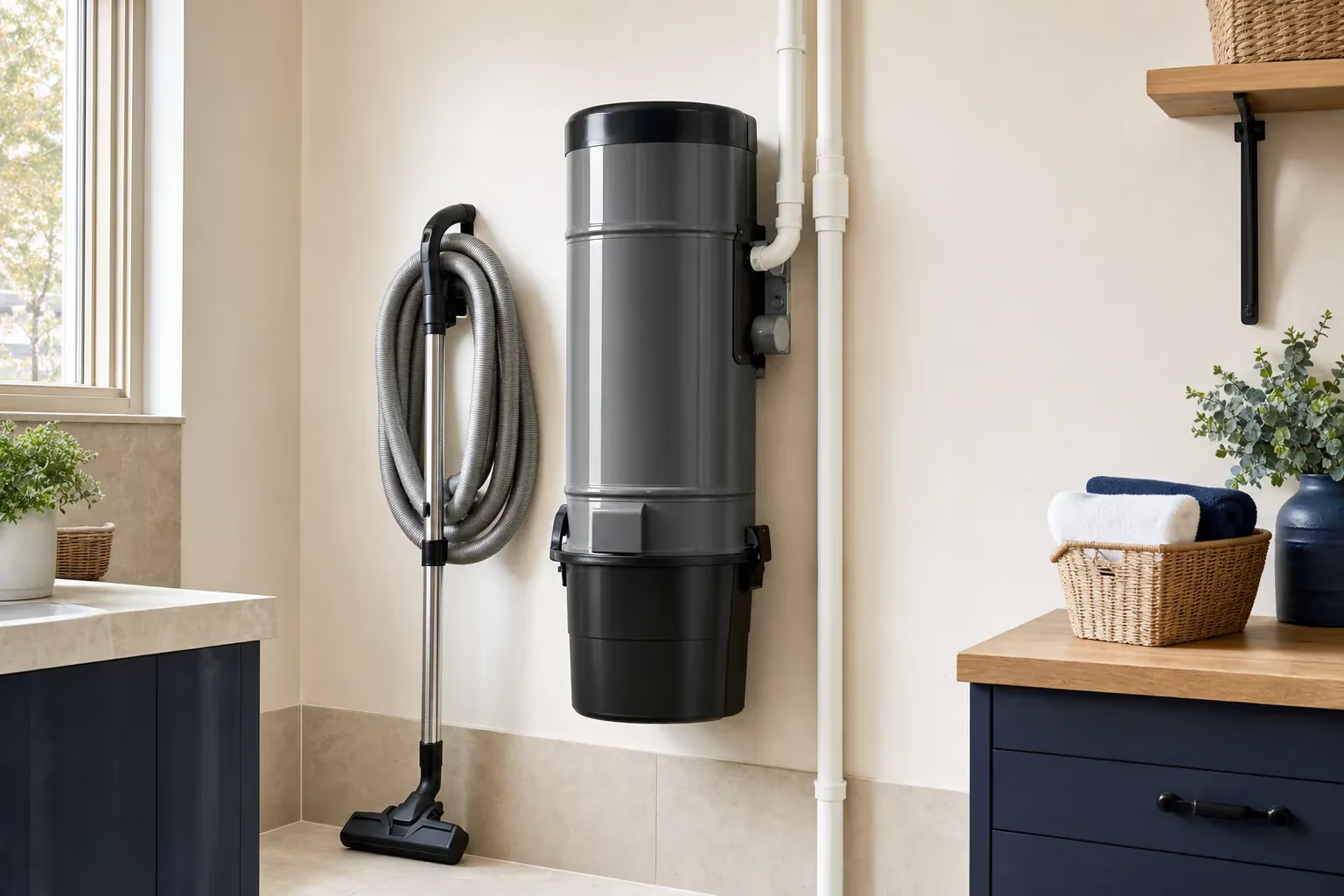
A central vacuum is a fixed in-house system: a main power unit with the motor in a storeroom or garage, pipes inside the walls, and wall inlets in each room where you plug in the hose. Because the motor is far away, suction is strong and it is much quieter in the rooms. Its parts: the power unit, the collection canister, the pipes, the inlets, the hose and the powerhead. Common faults: worn motor carbon brushes, a blocked pipe, an air leak at an inlet, or a broken low-voltage wire between an inlet and the unit.
Signs your Central Vacuum System needs service
- Weak suction at every inlet
- Weak suction at one particular inlet
- The power unit sounds loud or uneven
- The unit won't start from any inlet
- One inlet doesn't switch the unit on
- A hot or burning smell from the unit
- An air leak from the pipes
- The hose is holed
- The unit cuts out by itself
Common technical faults
Faults we often meet when servicing this type.
- 01
Worn motor carbon brushes = uneven noise and weak suction
- 02
A blockage in the pipes inside the walls
- 03
An air leak at an inlet (a worn seal)
- 04
A faulty relay or control board in the power unit = the unit won't start at all
- 05
A clogged unit filter
- 06
A damaged electrical wire in the hose (for the powerhead)
- 07
A broken low-voltage wire or a faulty inlet switch = that inlet doesn't start the unit
- 08
A faulty powerhead
Central Vacuum System repair services
Clearing pipe blockages
Replacing inlet seals
Emptying and cleaning the collection canister
Replacing the unit filter
Repairing the hose's electrical wire
Repairing inlet switches and low-voltage wiring
Powerhead servicing
Tips to keep your Central Vacuum System running
- Empty the collection canister every 2–3 months, or before it fills up
- Replace the unit filter once a year or as the manual recommends
- Check the inlet seals every 6 months
- Don't vacuum up large objects (they will block the pipes inside the walls)
- Have a technician inspect the system once a year
- If the power unit cuts out: empty the canister, clean the filter and let it cool — it has thermal protection; call us if it keeps happening
Vacuum Cleaner fault guides
Fault guides that apply to this type — causes, safe checks and when to call a technician.
Central Vacuum System — frequently asked questions
Do you install central vacuums in villas?
Our core work is servicing existing central systems. If you need a new system installed, call 16062 and we will tell you whether it is available; the duration and cost are set after a site visit, depending on the size of the home and the finishing stage.
Suction is weak at one particular inlet — why?
Either that inlet is blocked, or its seal is worn and air is leaking out. If the inlet doesn't start the unit at all, it is usually the low-voltage wire or the inlet switch. A technician checks it.
Is a central vacuum better than a regular one?
In a large villa it has advantages: stronger suction, fine dust isn't blown back into the rooms, it is much quieter in the rooms because the motor is far away, and there is no vacuum to carry around. But installation is costly.
Do you work on Beam and Vacuflo?
Yes — we work on Beam, Vacuflo, Husky, Cyclovac and other systems, subject to parts availability.
How long does a central system last?
A central system usually lasts longer than regular vacuums, especially with yearly preventive maintenance; the motor needs its carbon brushes replaced from time to time.
Other Vacuum Cleaner types
Need a technician for your Central Vacuum System?
Inspection, a clear price before the repair, and a 6-month written warranty.