
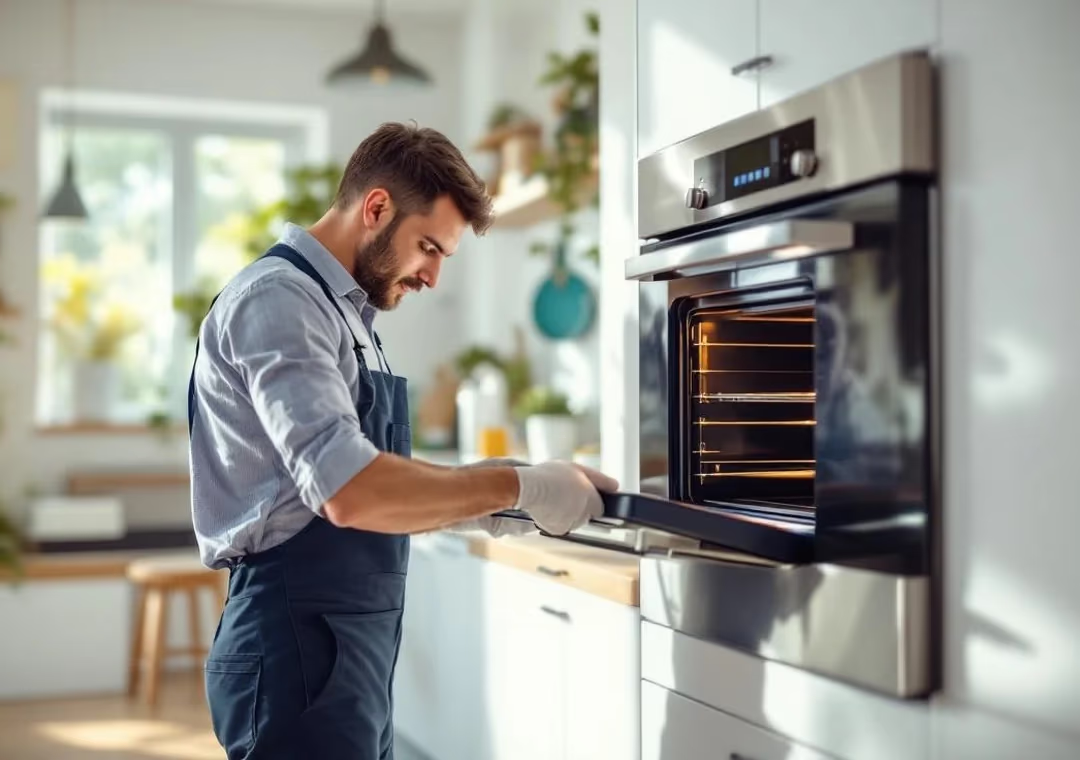
Oven technician inspecting a thermocouple and heating element on a Bosch oven
Calls 24h · Visits 9 AM–9 PM

Oven Repair in Egypt

Gas, electric and grill oven repair, including fan heaters

6-month written warranty on the repair and the replaced part

Agent Site is an independent repair center — not the manufacturer's authorized service or warranty provider.

6-month warrantyIn writing, with an official invoice
Visit hoursDaily 9 AM–9 PM
Spare partsOriginal or compatible
Specialist techniciansFor gas ovens

We repair gas, electric and built-in ovens: an oven that won't heat, a flame that goes out after a few seconds (thermocouple), ignition that won't light (spark electrode), a worn door gasket and control board faults. Technicians who specialize in gas appliances and safety procedures, original or compatible parts depending on the part and model, and a 6-month written warranty.

Specialized Oven Repair Services

From thermocouples and control boards to heating elements and pyrolytic self-cleaning — every repair carries a 6-month written warranty.

Book a service

Thermocouple Replacement

The thermocouple is the flame-safety sensor in a gas oven — when it weakens, the flame goes out as soon as you release the knob. We replace it with an original or compatible part to suit the model, for Bosch, Indesit, Zanussi and other brands.

See common faults

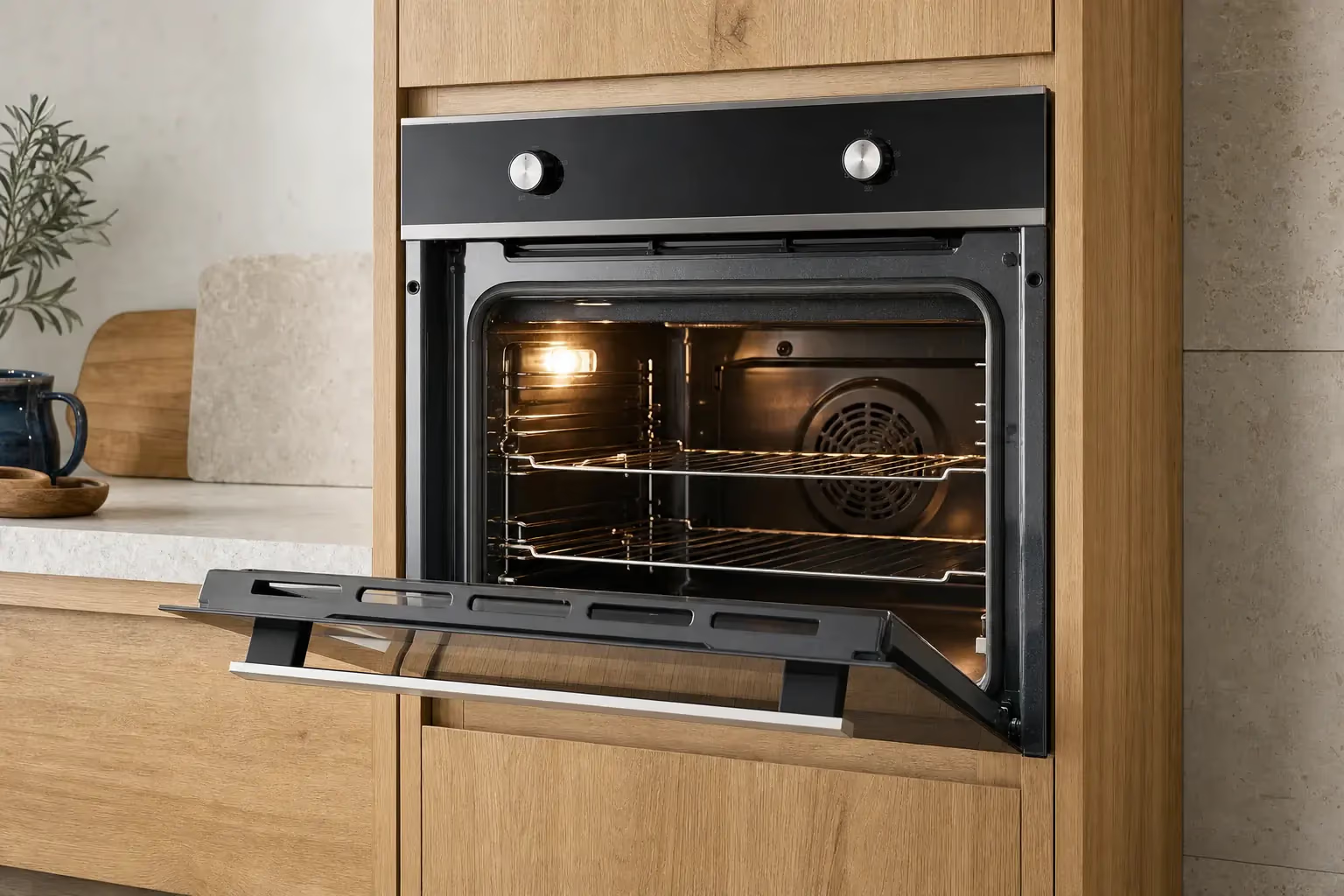
Heating Element Replacement

Top and bottom elements plus the convection (fan) element — the technician tests each one with a multimeter before replacing it, with a 6-month written warranty.

Built-in Oven Installation

Fitting the built-in oven into the kitchen cabinet to the dimensions in the model's manual, with the gas or electrical hookup and a test run before handover.

Door Gasket Replacement

A worn door gasket lets heat escape, so food cooks slowly and the oven uses more energy. We fit an original or compatible gasket to suit the model.

Restaurant & Bakery Ovens

A pizza, convection, deck or combi oven in a restaurant, bakery or hotel? Commercial ovens have their own page: commercial oven repair.

Restaurants & hotels

Control Board Repair

Electronic control board repair on modern ovens, including Bosch Serie 8 and Miele Generation 7000, using specialist test equipment.

Ovens service areas

We cover Cairo, Giza, Qalyubia, Alexandria, Matrouh (North Coast), Sharqia, Gharbia, Dakahlia. Not sure about your area? Call 16062 and we confirm before booking.

  • Cairo
  • Giza
  • Qalyubia
  • Alexandria
  • Matrouh (North Coast)
  • Sharqia
  • Gharbia
  • Dakahlia

Common Oven Faults & Their Fixes

For each fault: the symptoms, the likely causes, safe checks you can do yourself, and when to stop using the oven and call a technician. If you smell gas, shut the gas valve and call the gas emergency line 129 first.

Oven not heating

Medium Oven not reaching the set temperature? Usually a burnt-out element (electric) or a faulty thermocouple or thermostat (gas). Safe checks and when to call a technician.

If your oven won't reach the set temperature or takes far longer than usual, the usual cause is a burnt-out heating element (electric ovens) or a faulty thermocouple or thermostat (gas ovens). A technician pinpoints the fault by testing and fits an original or compatible part, depending on the model.

Symptoms

  • The oven doesn't reach the temperature you set
  • It takes more than 20–25 minutes to reach 180°C (most ovens get there in about 10–15)
  • The oven cuts out before it gets hot
  • The temperature rises and falls instead of holding steady
  • Food doesn't cook properly even with extra time
  • Bread or cakes come out raw in the middle
  • Hot at the bottom but cold at the top
  • No heat at all

Likely causes

  1. A burnt-out top or bottom heating element (electric ovens)
  2. A weak thermocouple letting the flame go out (gas ovens)
  3. A faulty oven thermostat
  4. A temperature sensor (NTC) giving wrong readings
  5. A worn door gasket letting heat escape
  6. A faulty electronic control board
  7. Gas ovens: a safety (magnetic) valve that doesn't open properly
  8. A convection fan that has stopped (on fan models)
  9. A tripped internal thermal cut-off
  10. Low mains voltage, so the element gives off less heat

Safe checks before you call a technician

  1. Check the door gasket With the oven cold, look at the rubber gasket around the door: if it is cracked, flattened or has pieces missing, heat is escaping and it needs replacing.
  2. Check the settings Make sure you have chosen the right mode (bake, grill or fan) and temperature, and that you let the oven preheat before putting the food in. On many ovens the bake setting only uses the bottom element.
  3. Restart the control board On digital ovens: switch the oven off at the breaker or plug for 5 minutes, then back on. This sometimes clears a temporary control-board glitch.

When to stop and call a technician

  • The oven still won't heat at all after these checks
  • The temperature still won't hold steady
  • You smell gas: shut the gas valve, open the windows and call the gas emergency line 129 first
  • The outside of the oven is getting hotter than usual
Call now 16062

Oven types where this fault is common: Gas OvenElectric OvenGrill Oven

Flame goes out after a few seconds (thermocouple)

Medium Gas oven lights, then the flame dies after a few seconds? The most common cause is the thermocouple, the flame-safety sensor. Usually a simple repair for a technician.

If your gas oven lights but the flame goes out as soon as you release the knob, or a few seconds later, the thermocouple is the usual cause. It is a safety sensor: while the flame keeps it hot, it holds the safety valve open; if the flame goes out, it shuts off the gas so none can leak. Over time it weakens, gets dirty or bends away from the flame.

Symptoms

  • The flame lights, then dies after a few seconds
  • You have to hold the knob in much longer than usual to keep it lit
  • The flame goes out on its own after the oven has been running for a while
  • The top grill works but the bottom oven burner won't stay lit
  • It lights normally, then suddenly goes quiet
  • The problem comes and goes — sometimes it stays lit, sometimes not

Likely causes

  1. A weak or failed thermocouple (the most common cause)
  2. The thermocouple tip is coated in grease or soot
  3. The thermocouple is bent or sits too far from the flame
  4. A loose connection between the thermocouple and the safety (magnetic) valve
  5. A weak safety valve (less common)
  6. Low gas pressure or a partly blocked burner, so the flame doesn't heat the thermocouple enough

Safe checks before you call a technician

  1. Turn off the gas and let the oven cool Before any check, turn the oven knob off, close the gas valve and wait until the oven is completely cold.
  2. Look at the thermocouple The thermocouple is the thin metal probe whose tip sits next to the oven burner. If the tip is coated in grease or soot, wipe it with a dry cloth. If it looks bent or away from the flame, don't adjust it yourself — it is a safety part, so let a technician reposition or replace it.

When to stop and call a technician

  • The flame still goes out after cleaning
  • The thermocouple is bent or away from the flame
  • The oven goes out on its own after running for a while
  • You smell gas: shut the valve, open the windows and call the gas emergency line 129 — don't try to relight it
Call now 16062

Oven types where this fault is common: Gas Oven

Burnt-out heating element

Technician Electric oven element burnt out and not heating? How to spot it — a technician tests it with a multimeter and fits an original or compatible part with a written warranty.

The heating element is the metal coil that turns electricity into heat inside an electric oven — one at the top, one at the bottom and, on many models, a third around the fan. If one of them no longer glows, or shows a burnt spot, a crack or a blister, it has probably failed and needs replacing. A technician confirms this with a multimeter resistance test after switching off the breaker.

Symptoms

  • The top element doesn't heat (the oven is cold at the top)
  • The bottom element doesn't heat (the oven is cold at the bottom)
  • Dark spots or burn marks on the element
  • The element is blistered or cracked
  • Crackling or sparks from the element when it switches on
  • Only part of the element glows
  • The breaker trips when you switch the oven on
  • A burning electrical smell

Likely causes

  1. Long hours at high temperatures
  2. A sudden voltage surge
  3. Aluminum foil touching the element and shorting it
  4. Grease baked onto the element
  5. The element has reached the end of its life
  6. Worn internal wiring that overheats or arcs
  7. Very frequent pyrolytic self-cleaning at extreme heat can strain the element

Safe checks before you call a technician

  1. Switch off and let it cool Switch off the oven's breaker or unplug it and wait until it is completely cold before any check — an electric oven runs on 220 volts. Don't remove the back panel or replace the element yourself — that is a technician's job, with proper test equipment.
  2. Look at the element Open the oven door and look at the top and bottom elements: large dark spots, a crack or a blister in one place usually mean the element has burnt out.

When to stop and call a technician

  • You suspect a burnt-out element — replacing it is a technician's job
  • The breaker trips as soon as you switch the oven on — don't switch it on again
  • You smell burning wiring or see sparks
Call now 16062

Oven types where this fault is common: Electric OvenGrill Oven

Gas smell from the oven

Technician Smell gas near the oven? Shut the gas valve, open the windows, don't touch any switch, get out and call the gas emergency line 129.

Any smell of gas from or around the oven is a real danger — a gas leak can cause an explosion or a fire. Safety first: shut the gas valve, open the windows, don't switch anything electrical on or off and don't use a lighter, then leave and call the gas emergency line 129. Once the gas emergency team has made the place safe, call us on 16062 to inspect the oven and its connections. The usual causes are a loose gas fitting, a cracked hose or a valve that no longer closes fully.

Symptoms

  • A strong or faint smell of gas near the oven
  • Bubbles form on the fittings in a soapy-water test
  • Headache or dizziness when you are near the oven
  • A hissing sound from the valve or the hose
  • The flame burns higher than usual
  • The pilot light (on older models) won't stay lit
  • The smell is still there after closing the oven's gas valve

Likely causes

  1. A loose gas fitting (the most common cause)
  2. A gas hose that is cracked or has hardened with age
  3. The oven's safety (magnetic) valve doesn't close fully
  4. The oven was installed incorrectly
  5. A gas knob left open without the burner lighting
  6. Worn seals in the fittings
  7. Rusty gas pipes
  8. The pilot light has gone out while gas still flows (older models)

Safe checks before you call a technician

  1. Shut the gas valve immediately Close the main gas valve (in the kitchen or next to the meter). This is the first and most important step. Don't switch anything electrical on or off, don't strike a lighter or match, and don't turn on the extractor hood.
  2. Open the windows Open the windows and doors so the gas can disperse.
  3. Get out and call 129 Leave the apartment and call the gas emergency line 129 from outside the building (if there is a fire, call the fire brigade on 180). Don't go back in until the gas emergency team says it is safe.

When to stop and call a technician

  • Any gas smell is an emergency: call the gas emergency line 129 first, not the repair line
  • Once the gas emergency team has made it safe, call us on 16062 to inspect the oven and its connections
  • Have the gas hose and fittings checked once a year so it doesn't happen again
Call now 16062

Oven types where this fault is common: Gas Oven

Uneven heating in the oven

Medium Food burning on one side and raw on the other? Usually one failed element, a stopped convection fan or a worn door gasket. A simple toast test shows the problem.

If food cooks on one side and stays raw on the other, the heat isn't being spread properly. The usual causes: one element working while the other isn't (electric ovens), a convection fan that has stopped, a door gasket worn on one side or, in a gas oven, partly blocked burner holes.

Symptoms

  • Food burns on one side and stays raw on the other
  • The sides are hotter than the middle
  • The top is hotter than the bottom (or the other way round)
  • Cakes or bread rise more on one side
  • You have to turn the tray halfway through
  • Some parts of the oven are much cooler
  • The convection fan doesn't turn or sounds odd

Likely causes

  1. A failed top or bottom element
  2. A stopped or weak convection fan
  3. A door gasket worn on one side, letting heat escape
  4. A temperature sensor out of position
  5. Grease built up on one element
  6. Gas ovens: partly blocked burner holes

Safe checks before you call a technician

  1. Check the door gasket With the oven cold, look at the rubber gasket around the door. If it is cracked or worn on one side, it needs replacing.
  2. Do a toast test Place three slices of toast in different spots on the same shelf and run the oven at 180°C for about 10 minutes. The paler slices show the cooler areas.
  3. Clean off the grease Unplug the oven and let it cool, then wipe away built-up grease with a cloth and a suitable oven cleaner — without spraying water or cleaner onto the element's connections.

When to stop and call a technician

  • One element isn't heating
  • The convection fan isn't turning
  • There is a big temperature difference between parts of the oven
Call now 16062

Oven types where this fault is common: Gas OvenElectric OvenGrill Oven

Oven door won't close properly

Medium Oven door loose or not closing properly? Usually the hinges or the door gasket. Heat escapes and energy use goes up — here is what to check.

If the oven door doesn't close properly, heat escapes, food doesn't cook evenly and gas or electricity use goes up. The usual causes: hinges worn from years of opening and closing, a cracked rubber door gasket or a weak door spring.

Symptoms

  • The door doesn't close all the way
  • The door is loose and wobbles when opened
  • Steam or heat escapes around the door
  • The door squeaks or sticks when opening or closing
  • The rubber gasket is dried out or cracked
  • The hinges have come loose from the oven body
  • The door drops open suddenly (a broken spring)
  • The inner door glass is cracked or broken

Likely causes

  1. Worn door hinges (the most common cause)
  2. A door gasket cracked by heat
  3. A weak or broken door spring
  4. A faulty door lock (on pyrolytic models)
  5. Cracked inner door glass
  6. Loose hinge screws
  7. The door or oven body bent by being forced open or slammed

Safe checks before you call a technician

  1. Inspect the gasket With the oven cold, look at the rubber gasket around the door: cracks, bulges or missing pieces mean it needs replacing.
  2. Check the hinges With the oven off and cold, open the door and look at the hinges. If the visible screws are loose, tightening them may fix the problem for now.
  3. Don't force the door Open and close the door gently — slamming it or leaning on it while it is open wears out the hinges quickly.

When to stop and call a technician

  • The gasket needs replacing
  • A hinge is broken
  • The door glass is cracked — don't use the oven
  • Pyrolytic cleaning won't run because of the door lock
Call now 16062

Oven types where this fault is common: Gas OvenElectric OvenGrill Oven

Auto-ignition not working

Simple Gas oven auto-ignition not lighting? Usually a dirty or damaged spark electrode or ignition module. Check it safely with the gas turned off.

If you press the oven knob and hear no ignition clicking, or it clicks but the burner won't light, the usual cause is a dirty or damaged spark electrode or a faulty ignition module. Important: if the burner hasn't lit within 10–15 seconds, turn the knob off, open the oven door and wait a few minutes for the gas to clear before trying again.

Symptoms

  • No clicking when you press the knob
  • It clicks but the burner won't light
  • Ignition works on one burner but not another
  • You've had to start lighting the oven with a match
  • The clicking won't stop
  • It only lights after several tries

Likely causes

  1. A spark electrode fouled with grease or food
  2. A cracked or damaged spark electrode
  3. A faulty ignition module
  4. A disconnected or damaged electrode wire
  5. The burner cap is out of place, so the spark is too far from the gas
  6. Low gas pressure

Safe checks before you call a technician

  1. Clean the spark electrode With the oven cold and the gas valve closed, wipe the electrode (the small metal tip next to the burner) with a dry brush or cloth. Don't sand the ceramic part, and let it dry completely before using the oven.
  2. Check the burner cap With the oven cold, make sure the burner cap sits correctly in place — if it has shifted, the spark is too far from the gas.
  3. Check the power If there is no clicking at all, check that the oven is plugged in and the socket works (try another appliance). Beyond that, don't take the control panel apart — call a technician.

When to stop and call a technician

  • Cleaning didn't help
  • There's no clicking at all even though the power is fine
  • The clicking won't stop
  • You smell gas: shut the valve, open the windows and call the gas emergency line 129
Call now 16062

Oven types where this fault is common: Gas Oven

Oven light not working

Simple Oven light not working? Usually a blown bulb that is simple to replace — a heat-resistant oven bulb (often E14 or G9), with the oven unplugged and cold.

A dead oven light is a simple, non-dangerous fault, but you need it to keep an eye on your cooking. It must be a heat-resistant oven bulb — usually with an E14 or G9 base, depending on the model (check the manual). Replacing it is easy with the oven unplugged and cold.

Symptoms

  • The bulb doesn't light
  • The bulb flickers on and off
  • The light is dim
  • A crackling sound near the bulb
  • The bulb is visibly broken

Likely causes

  1. A blown bulb (the most common cause)
  2. Rust or grease in the bulb holder
  3. A disconnected lamp wire
  4. A faulty light switch
  5. A loose glass cover
  6. An ordinary, non-heat-resistant bulb was fitted

Safe checks before you call a technician

  1. Switch off the power Unplug the oven or switch off its breaker, and let it cool before touching the bulb.
  2. Replace the bulb Remove the glass cover (by its screw or by twisting it, depending on the model), take out the old bulb and fit a heat-resistant oven bulb with the same base and wattage as the old one or as stated in the manual. Don't use an ordinary bulb — it must be a heat-resistant oven bulb.

When to stop and call a technician

  • A new bulb still won't light — probably the wiring or the switch
  • The light switch is faulty
  • The bulb holder is burnt
Call now 16062

Oven types where this fault is common: Gas OvenElectric Oven

Electronic control board failure

Technician Oven display dead or buttons not responding? It may be a temporary glitch or a control board fault. Try a safe restart first; anything more is a technician's job.

Modern ovens have an electronic control board that runs the temperature, timer, programmes and self-cleaning. If the display is dark, the buttons don't respond or the oven turns itself on and off, it may be a temporary glitch that a restart clears, or a fault in the board itself that needs a technician.

Symptoms

  • The display is completely dark
  • The display shows codes or odd symbols
  • The buttons don't respond
  • The oven switches on and off by itself
  • The automatic programmes don't work
  • Settings change on their own
  • The touch screen doesn't respond (touch models)
  • Constant beeping

Likely causes

  1. Power fluctuations damaging components on the board
  2. A sudden voltage surge
  3. Moisture or steam reaching the board
  4. A software (firmware) glitch
  5. A loose connector between the board and other parts
  6. A stopped cooling fan letting the board overheat

Safe checks before you call a technician

  1. Restart the oven Switch the oven off at the breaker or plug for 10 minutes, then back on. This sometimes clears a temporary software glitch in the control board.
  2. Check the power Try the socket with another appliance, and notice whether the lights in the house flicker or the power keeps dropping — that could be the cause.

When to stop and call a technician

  • The problem comes back after a restart — board repair is a technician's job
  • The display keeps showing an error code
  • You smell burning near the controls or the board — switch the oven off at once
Call now 16062

Oven types where this fault is common: Gas OvenElectric Oven

Oven fan making a loud noise

Medium Oven fan (convection or cooling) loud or making odd noises? Usually worn bearings or something caught in it. Check it safely with the oven unplugged.

Many modern ovens have two fans: the convection fan inside the cavity spreads the heat, and the cooling fan keeps the control board and electronics cool. An odd noise from either one usually means worn bearings, a bent blade or something caught in the fan.

Symptoms

  • A constant grinding noise from the fan
  • A loud whine while the fan turns
  • A metallic scraping sound
  • The outside of the oven gets very hot (cooling fan not working)
  • Uneven heat (convection fan not working)
  • Clicking near the fan
  • The fan turns slowly

Likely causes

  1. Fan bearings worn with use
  2. A bent or broken fan blade
  3. Something caught in the fan
  4. Grease built up on the blades
  5. A failed fan motor
  6. The fan cover inside the oven is loose and rattling

Safe checks before you call a technician

  1. Unplug and look Unplug the oven and let it cool. If you can see the fan from inside the oven, remove anything caught in it (food or foil) without taking its cover off.
  2. Clean off the grease With the oven unplugged and cold, clean the grease around the fan cover inside the oven with a cloth and oven cleaner.

When to stop and call a technician

  • The noise continues after cleaning — replacing the motor or bearings is a technician's job
  • The cooling fan has stopped (the control board can overheat)
  • The fan is turning very slowly
Call now 16062

Oven types where this fault is common: Gas OvenElectric Oven

Pyrolytic cleaning not working

Technician Pyrolytic self-cleaning won't start or the door won't lock? Usually the door-lock motor or the temperature sensor. What to try — codes differ by brand.

Pyrolytic self-cleaning is found on many electric ovens from Bosch, Miele and others: the oven heats to around 450–500°C and turns grease into ash, and the door locks automatically for the whole cycle for safety. If the mode won't run, the cause is usually the door-lock motor or the temperature sensor.

Symptoms

  • Self-cleaning mode won't start
  • The door doesn't lock when you select self-cleaning
  • The cycle starts, then stops with an error code
  • The oven doesn't get hot enough, so the grease doesn't turn to ash
  • An error code on the display — its meaning depends on the brand and model
  • The door stays locked after the oven has cooled down

Likely causes

  1. A failed door-lock motor
  2. A faulty temperature sensor, so the oven won't start the cycle for safety
  3. A weak element that can't reach cleaning temperature
  4. A control board fault
  5. Very heavy grease build-up (most manuals say to remove it before the cycle)
  6. A stopped cooling fan — on many models the oven won't complete the cycle without it

Safe checks before you call a technician

  1. Clear the oven first With the oven cold, remove food residue, heavy grease, racks and trays before the cycle, as the manual says.
  2. Check the settings Follow the self-cleaning steps in your oven's manual — each brand does it differently, and sometimes the door must be firmly closed or the child lock switched off first.

When to stop and call a technician

  • The cycle still won't run after these steps
  • The door won't lock, or stays locked after the oven has cooled — don't force it open
  • An error code keeps coming back — photograph it and send it to us with the oven model
Call now 16062

Oven types where this fault is common: Electric Oven

Smoke from the oven

Technician Smoke from the oven while it runs? Usually burning grease — but black smoke, sparks or soot from a gas oven are dangerous. Here is what to do right away.

The most common cause of smoke is grease or food residue burning inside the oven — annoying, but usually not dangerous. Black smoke or sparks from an electric oven, however, can mean an element shorting against foil or burnt wiring (a fire risk), and black smoke or soot from a gas oven means incomplete combustion and a carbon monoxide risk. If there are flames inside the oven, keep the door closed — and on a gas oven, shut the gas valve.

Symptoms

  • Light smoke while the oven is running
  • Heavy smoke coming out of the vents
  • Black smoke with a smell of burning plastic or wiring
  • Sparks near the heating element
  • Gas ovens: a yellow flame and black soot on trays or walls
  • Smoke even when the oven is empty and clean
  • Light smoke during pyrolytic self-cleaning — this is normal

Likely causes

  1. Built-up grease burning off (the most common cause)
  2. Aluminum foil touching the element
  3. Burnt food residue on the oven floor
  4. An element shorting against the oven body
  5. Burnt internal wiring
  6. Gas ovens: incomplete combustion from a blocked or badly adjusted burner
  7. Cleaner residue left from the last clean

Safe checks before you call a technician

  1. Black smoke: shut the oven down now Electric oven: switch it off at the breaker or unplug it. Gas oven: turn the knob off, shut the gas valve and open the windows. If there are flames inside the oven, keep the door closed, and if they don't go out, call the fire brigade on 180. Never throw water on a live oven or a grease fire — there is a risk of electric shock and of spreading the fire.
  2. Clean the oven If the smoke is light and white (grease), wait for the oven to cool, then clean it thoroughly with an oven cleaner and wipe away any cleaner residue.
  3. Remove any foil Once the oven is switched off and cool, remove any foil touching the element or lining the oven floor.

When to stop and call a technician

  • Any black smoke — don't use the oven again until a technician has checked it
  • Sparks or a smell of burning plastic come with the smoke
  • The oven is clean but still smokes
  • A gas oven produces soot or burns with a yellow flame
Call now 16062

Oven types where this fault is common: Gas OvenElectric OvenGrill Oven

Inaccurate temperature

Medium Oven set to 180°C but the real temperature is far higher or lower? Usually the thermostat or the temperature sensor. Test it with an oven thermometer.

If the oven is set to 180°C but food burns (the real temperature is higher) or won't cook (lower), the thermostat or the temperature sensor (NTC) usually needs recalibrating or replacing. A simple oven thermometer left inside for 20 minutes shows the gap between the setting and the real temperature.

Symptoms

  • Food burns even at a low setting
  • Food won't cook even at a high setting
  • Cooking takes noticeably less or more time than usual
  • Bakes burn underneath before the top is done
  • A big gap between the set and the real temperature (more than 20°C)
  • The oven switches its heat on and off earlier or later than usual

Likely causes

  1. A faulty or out-of-calibration thermostat
  2. A temperature sensor (NTC) giving wrong readings
  3. Grease on the sensor
  4. A worn door gasket letting heat escape
  5. A weak element that can't reach the set temperature
  6. A control board fault

Safe checks before you call a technician

  1. Test with an oven thermometer Place an oven thermometer in the middle of the oven, run it at 180°C for 20 minutes and read the real temperature without opening the door too often. The gap shows the problem.
  2. Look for a calibration setting Some modern models have a temperature calibration option in the settings — the manual explains how.

When to stop and call a technician

  • The gap is more than 20°C
  • Adjusting the calibration setting wasn't enough
  • The sensor or thermostat needs replacing
Call now 16062

Oven types where this fault is common: Gas OvenElectric Oven

Oven too hot on the outside

Technician Oven casing hot enough to burn? Usually a stopped cooling fan or worn insulation. A burn risk, and a risk to the cabinet around it.

If the outside of the oven gets hot enough to burn, the cooling fan has usually stopped or the insulation is worn. The cooling fan keeps heat away from the casing and the control board; when it stops, the heat can damage the board and the surrounding cabinet, and there is a risk of burns.

Symptoms

  • The oven casing is hot enough to burn
  • The knobs and handle get very hot
  • The outer door glass is very hot
  • You can't hear the cooling fan
  • The control board plays up after long use
  • The oven cuts out because of overheating
  • The wooden cabinet around the oven is darkening

Likely causes

  1. A failed cooling fan that no longer turns
  2. A weak cooling fan with worn bearings
  3. A burnt-out cooling fan motor
  4. Oven insulation worn over the years
  5. Cooling vents clogged with dust and grease
  6. The oven is fitted in too tight a space (poor ventilation)

Safe checks before you call a technician

  1. Clean the vents With the oven off and cold, check the ventilation slots on the top and sides and clean off any dust or grease.
  2. Check the installation If the oven is built in, make sure the ventilation gaps around it aren't blocked and the clearances match the installation manual.

When to stop and call a technician

  • The casing is still hot enough to burn — stop using the oven until a technician has seen it
  • The cooling fan isn't working
  • The cabinet around the oven is being damaged by the heat
Call now 16062

Oven types where this fault is common: Gas OvenElectric Oven

Error code on the oven display

Medium Is your oven showing an error code? Code meanings differ by brand and model — photograph the code and model label, check the manual, or WhatsApp it to us.

Modern digital ovens show an error code on the display to help with diagnosis. What a code means depends on the brand and model — the same code can mean one thing on one brand and something completely different on another. Photograph the code and the model label and check the code table in your oven's manual, or WhatsApp it to us on 01050887010.

Symptoms

  • Letters and numbers on the display (such as E or F followed by digits) and the oven has stopped
  • A code appears mid-cook and the oven stops heating
  • LOC or a lock symbol on the display — on many models this is the control (child) lock, not a fault
  • The code clears after a restart but comes back
  • Continuous beeping with the code
  • The oven won't start and the code stays on

Likely causes

  1. Every brand has its own code table
  2. A faulty or disconnected temperature sensor (NTC)
  3. A door-lock problem (on self-cleaning models)
  4. A failed heating element
  5. A control board fault
  6. A communication fault between the control board and the display
  7. The overheat protection has tripped (for example, because of the cooling fan)

Safe checks before you call a technician

  1. Note the code Photograph the code and the label showing the oven's brand and model (usually on the edge of the opening when you open the door). That is the information a technician needs.
  2. Restart the oven Switch the oven off at the breaker or plug for 10 minutes, then back on. This sometimes clears a code caused by a temporary glitch.
  3. Check the manual The code table is in the oven's manual (or on the manufacturer's website under your model). Sometimes the code is something simple, like a door that isn't fully closed or the child lock being on.

When to stop and call a technician

  • The code comes back after a restart
  • The manual says the code relates to an element, a sensor or the control board
  • More than one code appears
Call now 16062

Oven types where this fault is common: Gas OvenElectric Oven

How We Work

  1. 01

    Call or WhatsApp

    Reach us on 16062 or WhatsApp 01050887010, and describe the problem in a minute.

  2. 02

    Your visit is scheduled

    Technician visits daily from 9 AM to 9 PM — at the earliest available slot for your area.

  3. 03

    Diagnosis + written quote

    Instrument-based diagnosis and a written quote — set after inspection, before any work.

  4. 04

    The repair

    Original or compatible replacement parts, depending on the part and model, with a test run before handover.

  5. 05

    6-month written warranty

    Official invoice + 6-month written warranty on the repair and the replaced part.

Book your oven service

at the earliest available slot for your area

  • 6-month written warranty on the repair and the replaced part
  • Technician visits daily from 9 AM to 9 PM
Call now16062

Your service details

We save your request and call you to confirm the appointment; WhatsApp opens with the details too.

Why Agent Site for Oven Service?

Home oven repair by specialist technicians, with a written price before any work and a written warranty.

9–9daily

Fixed Visit Hours

Technician visits run daily from 9 AM to 9 PM at the earliest available slot for your area, and the 16062 hotline answers calls 24 hours a day.

Gas-Oven Specialist Technicians

The technicians who work on gas ovens specialize in gas appliances and safety procedures.

Original or Compatible Parts

Thermocouples, heating elements, door gaskets and control boards — original or compatible depending on the part and model, covered by a 6-month written warranty.

12+ brands

Full Brand Coverage

Bosch, Indesit, Zanussi, Kiriazi, Fresh, Universal, Electrolux, Miele, Beko — and other brands sold in Egypt.

Every Technology Covered

From the traditional gas oven to electric ovens with pyrolytic self-cleaning and steam ovens.

6months

Written Warranty

An official invoice + a 6-month written warranty covering the repair we did and the part we replaced.

Oven Service — Frequently Asked Questions

The questions that come to mind before requesting oven service.

How much does oven repair cost?

The price depends on the fault and the part (thermocouple, heating element, control board…), the oven type (gas, electric or built-in) and part availability. The technician inspects the oven and gives you the price in writing before any work starts — followed by an official invoice and a 6-month written warranty.

How soon can a technician come for oven repair?

Visits run daily from 9 AM to 9 PM at the earliest available slot for your area, across the governorates we cover (Cairo, Giza, Qalyubia, Alexandria, Matrouh, Sharqia, Gharbia and Dakahlia). The 16062 hotline answers calls 24 hours a day and books your visit.

Do you service every oven brand?

Yes — we repair home ovens from all the brands sold in Egypt, using original or compatible parts depending on the part and model. For a commercial oven in a restaurant or bakery, see commercial oven repair.

Is there a warranty on the service?

Yes — a 6-month written warranty covering the repair we did and the part we replaced, with an official invoice.

Do you install new ovens?

Yes — we install gas, electric and built-in ovens: the gas or electrical connection, a soapy-water leak test on gas ovens, and a test run before handover.

Oven technician inspecting a thermocouple and heating element on a Bosch oven
Hotline 16062 answers calls around the clock

Need oven service right now?

A specialist oven technician at the earliest available slot for your area. Official invoice and a 6-month written warranty.

← All devices