
Accurate diagnosis with a pressure gauge and leak detector
Air Conditioners
Split AC Repair
Split AC repair, standard and inverter: leak detection before any recharge, a deep clean of both units, error-code diagnosis. Clear price, 6-month warranty.
Agent Site is an independent repair center — not the manufacturer's authorized service or warranty provider.
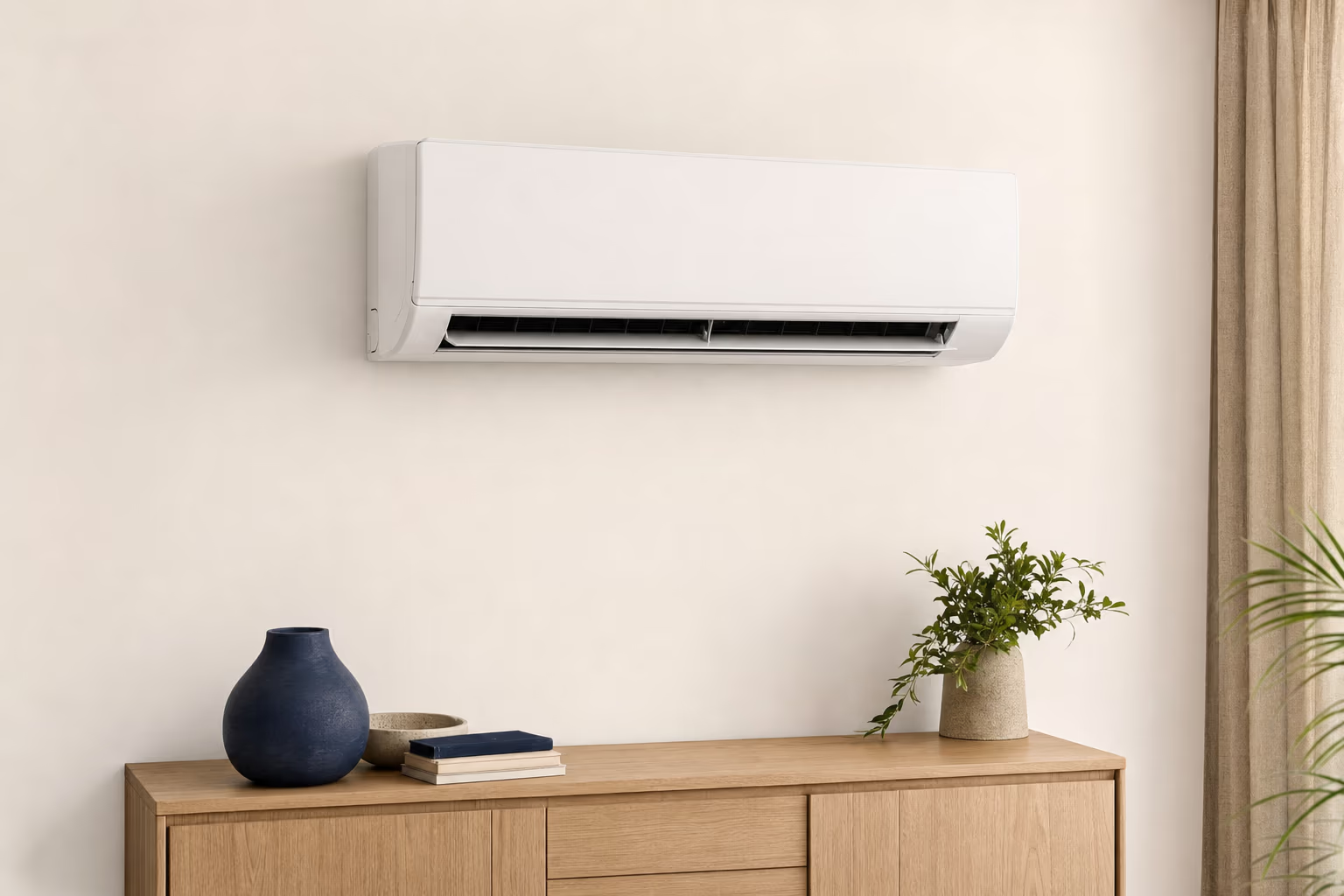
The split AC is the most common type in Egyptian homes. Split means "separated" — the indoor unit (evaporator) hangs on the wall, separate from the outdoor unit (condenser and compressor) on the balcony or roof. The advantage is that it runs quietly inside the room; the downside is that any leak in the refrigerant line reduces cooling — which is why servicing it needs a technician with pressure gauges. We repair most split AC brands sold in Egypt.
Why Does a Split AC Lose Cooling Over Time?
A split AC does not break down suddenly — it weakens gradually, which is why many people put up with weak cooling until the unit stops completely. The first and most common cause in Egypt is dust. The indoor evaporator and the outdoor condenser get covered in a layer of dust that acts like an insulating blanket, so the compressor has to run much longer to reach the same temperature — higher power consumption and a shorter lifespan.
The second cause is a slow refrigerant leak at the flare connections — especially if the original installation was not done properly. A slow leak does not show up within a week, but after a full season you find the AC "barely cooling". And here is an important rule: refrigerant never runs out on its own — any shortfall means a leak that must be found and brazed before any recharge, otherwise you will be paying for a recharge every season.
Inverter Split AC Service — What Makes It Different?
The inverter has become the best-selling type in Egypt because it saves electricity, but servicing it needs a technician trained specifically on inverters. The key difference: an inverter has an electronic board (PCB) that controls the compressor speed moment by moment — and that board is the part hit hardest by voltage surges and the power fluctuations common in Egypt.
- Common inverter faults: the outdoor control board (Outdoor PCB), temperature sensors, and the IPM module
- Inverters run on R-32 or R-410a refrigerant — higher pressures that require dedicated measuring tools
- Error codes appear on the indoor unit display — write the code down before you call; it speeds up diagnosis considerably
- Stable power matters: install a voltage stabilizer if your area has fluctuations — it costs far less than a new board
Signs your Split AC needs service
- The indoor unit drips water onto the wall
- The outdoor compressor starts and shuts off quickly
- Air comes out lukewarm, not cold, even in Cool mode
- Rattling or whistling noise from the outdoor unit
- The electricity bill jumped suddenly
- The remote sends a signal but the unit does not respond
- Ice forms on the thin copper line
- A musty or moldy smell when the unit runs
Common technical faults
Faults we often meet when servicing this type.
- 01
Refrigerant leak at the flare connections due to poor installation
- 02
Burnt compressor start capacitor
- 03
Clogged indoor drain hose from dust or algae
- 04
Dusty outdoor condenser blocking heat exchange
- 05
Burnt control board (PCB) from a voltage surge
- 06
Faulty room temperature sensor (thermistor) giving wrong readings
Inverter or Standard Split AC — What Is the Real Difference?
| Inverter | Standard (On/Off) | |
|---|---|---|
| How it works | The compressor varies its speed gradually as needed | Runs at full power, then switches off, and repeats the cycle |
| Power consumption | Noticeably cheaper to run with long daily use | Higher — every start-up draws a large starting current |
| Cooling consistency | A steady temperature with no noticeable on/off cycling | You feel alternating waves of cold and warm air |
| Noise | Quieter — usually runs at low speeds | Relatively louder at each start-up |
| Maintenance and faults | Faults are mostly electronic (board/sensors) and need a specialist technician | Simpler mechanical faults (capacitor/relay) and cheaper parts |
| Power sensitivity | Sensitive to voltage fluctuations — a voltage stabilizer is recommended | More tolerant of fluctuations |
| Best for | Long daily use (bedrooms/living rooms) — it recoups its price difference | Occasional use or guest rooms |
The bottom line: if you run the AC for long hours every day, an inverter usually pays back its price difference over time. If your use is occasional, a standard unit is simpler and cheaper to maintain. Either way, regular maintenance is what determines the real lifespan of the unit.
Split AC repair services
Recharging the right refrigerant for your unit (R-22, R-410A or R-32) by weight and pressure, after the leak is fixed
Deep cleaning of both indoor and outdoor units
Replacing parts — compressor, capacitors, fans — with original or compatible parts depending on the part and model
Installing a new split AC with insulated copper lines
Periodic preventive maintenance contracts
Tips to keep your Split AC running
- Clean the indoor unit filter every month in summer
- Keep the outdoor unit away from direct sunlight
- After turning the AC off, run it on Fan only for 15 minutes
- In winter, run the AC for 10 minutes once a month
- Do not set the AC below 18°C
- Have it washed and checked before summer and again after the season
How to Clean Your Split AC Yourself (Indoor Unit)
Safe steps you can do yourself between services — anything more complex, leave it to the technician on 16062.
- 1
Switch off the power at the breaker
Not just with the remote — switch off the AC circuit at the electrical panel or unplug it. Working on the unit while it is powered is dangerous.
- 2
Open the front cover and remove the filters
The cover lifts upward on hinges at both sides. The filters are plastic mesh screens that slide out easily without any tools.
- 3
Wash the filters in lukewarm water
Use running water plus a drop of soap if there is a lot of grease (if the kitchen is nearby, for example). Let them dry completely in the shade before refitting them — a damp filter breeds mold.
- 4
Brush the indoor fins with a soft brush
Use light vertical strokes in the direction of the fins — without pressing. Do not use water inside the indoor unit yourself.
- 5
Wipe the air outlet and blower fan with a damp cloth
The cylindrical blower wheel that distributes the air collects black dust — wipe it with a cloth dampened with water and a little white vinegar.
- 6
Refit the filters and run on Fan for 15 minutes
Before cooling, run the fan only for 15 minutes so any moisture inside dries out. If a musty smell remains after cleaning, the problem is in the evaporator itself and needs a deep wash by a technician.
Do not open sealed units or touch electrical, gas or refrigerant circuits yourself — that is specialist work with measuring instruments.
AC fault guides
Fault guides that apply to this type — causes, safe checks and when to call a technician.
Split AC repair by brand
Pick your brand to see its common faults and error codes.
Split AC — frequently asked questions
How long does it take to install a new split AC?
A full installation takes 2 to 4 hours depending on the distance between the two units. This includes the flare connections, water drainage and an operation test.
When does a split AC need a refrigerant recharge?
You do not recharge refrigerant on a routine basis — refrigerant does not run out. If cooling drops, there is a leak that must be found and repaired before recharging.
What is the difference between a standard split AC and an inverter?
An inverter varies the compressor speed as needed, so it uses noticeably less electricity with long daily use. A standard unit runs at full power and switches off (On/Off).
What is the lifespan of a split AC?
A split AC from a reputable brand typically lasts around 10-12 years with regular maintenance, and much less without it.
The compressor starts and shuts off quickly — what is the cause?
This is short cycling — causes include a weak start capacitor, low refrigerant, a dusty outdoor condenser, or a temperature sensor giving wrong readings.
How often should a split AC get routine maintenance?
A wash and inspection once before summer (March-April) and once after the season is enough for most homes. If you use it daily or live in a dusty area, clean the indoor unit filter yourself every two weeks between the two services.
How do I know if my split AC is low on refrigerant?
The signs: weak cooling even in Cool mode, ice forming on the thin copper line, a faint hissing near the unit, and a higher electricity bill. But it can only be confirmed with a pressure gauge — and low refrigerant always means a leak that must be repaired first.
What is the difference between servicing a split AC and a window AC?
A split AC is two separate units with a refrigerant line between them, so its service includes leak detection and pressure checks. A window AC is a single self-contained unit — simpler and faster to service, but louder and more power-hungry.
Does cleaning my split AC myself affect the warranty?
Cleaning the filter and the outside of the indoor unit is safe and does not affect the warranty. But opening the outdoor unit or touching the refrigerant circuit can void the manufacturer's warranty, and that work needs a specialist technician.
Other AC types
Need a technician for your Split AC?
Inspection, a clear price before the repair, and a 6-month written warranty.